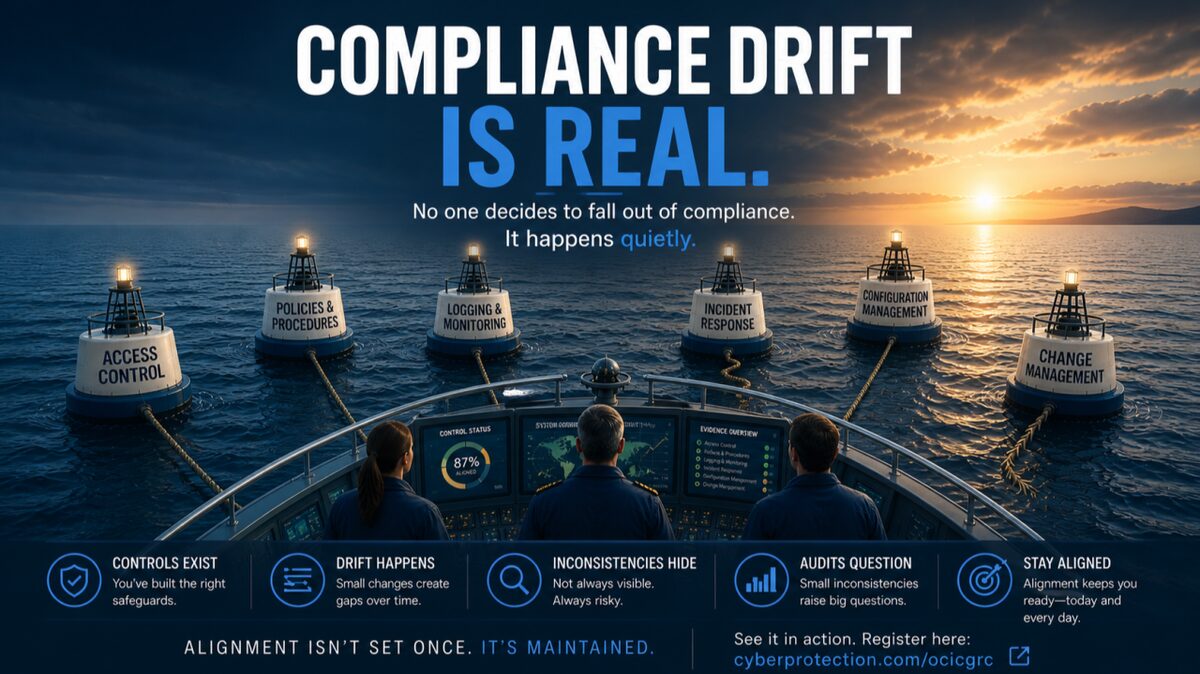
Compliance Drift Is Real
No one decides to fall out of compliance.
It happens quietly.
A system gets updated. A process changes. Someone new takes over a responsibility.
Nothing feels major in the moment.
Over time, things start to shift.
What is written down no longer fully matches what is happening. Controls are still in place, but not always in the same way. Evidence still exists, just not as consistently.
From the outside, everything looks intact.
Underneath, it is starting to move.
That is what makes drift hard to catch.
Most teams assume that once something is set up, it stays that way. In reality, environments are constantly changing. Without something keeping everything aligned, those changes add up.
This is where audits get uncomfortable.
Not due to something missing, but due to small inconsistencies that build over time.
A control was followed, just not every time. A review was completed, just not on schedule. A configuration exists, just not exactly how it was documented.
Individually, none of this feels serious.
Together, it raises questions.
Teams often try to correct this with more oversight. More check-ins. More reminders.
That helps for a while.
Then things start to drift again.
The difference comes when alignment is not something your team has to keep correcting.
It stays in place.
Inside OCIC, changes in your environment are reflected back into your controls and evidence automatically. What is happening stays aligned with what is documented, without someone constantly checking it.
That is what keeps things from slowly moving out of sync.
If you want to see how this works in a real environment, we walk through it live.
Register here: https://www.cyberprotection.com/ocicgrc