I wonder how often organizations mistake the presence of information for the presence of understanding.
Dashboards exist.
Reports are generated.
Alerts are triggered.
Documentation is maintained.
Evidence is collected.
And yet, leaders still struggle to answer some of the most important questions:
-
What are our biggest risks?
-
Where should we focus our attention?
-
Who owns the response?
-
Which issues require action now?
-
Do our assumptions still reflect reality?
The problem is rarely a complete lack of information.
In fact, many organizations have more information than ever before.
The challenge is making sense of it.
Over time, dashboards multiply. New tools are introduced. Reports become more detailed. Documentation expands. Evidence repositories grow.
The volume of information increases.
Confidence does not always increase with it.
Because information and understanding are not the same thing.
A dashboard may tell you that a control is enabled.
A report may show that evidence exists.
A policy may describe how a process is intended to function.
But none of those things automatically answer a more important question:
Does this still reflect reality?
Many organizations operate on assumptions that were reasonable when they were first established.
That CUI only resides in certain locations.
That specific individuals own particular responsibilities.
That vendors continue to support the same functions they always have.
That systems operate within the same boundaries they did months or years ago.
Often, those assumptions are never intentionally revisited.
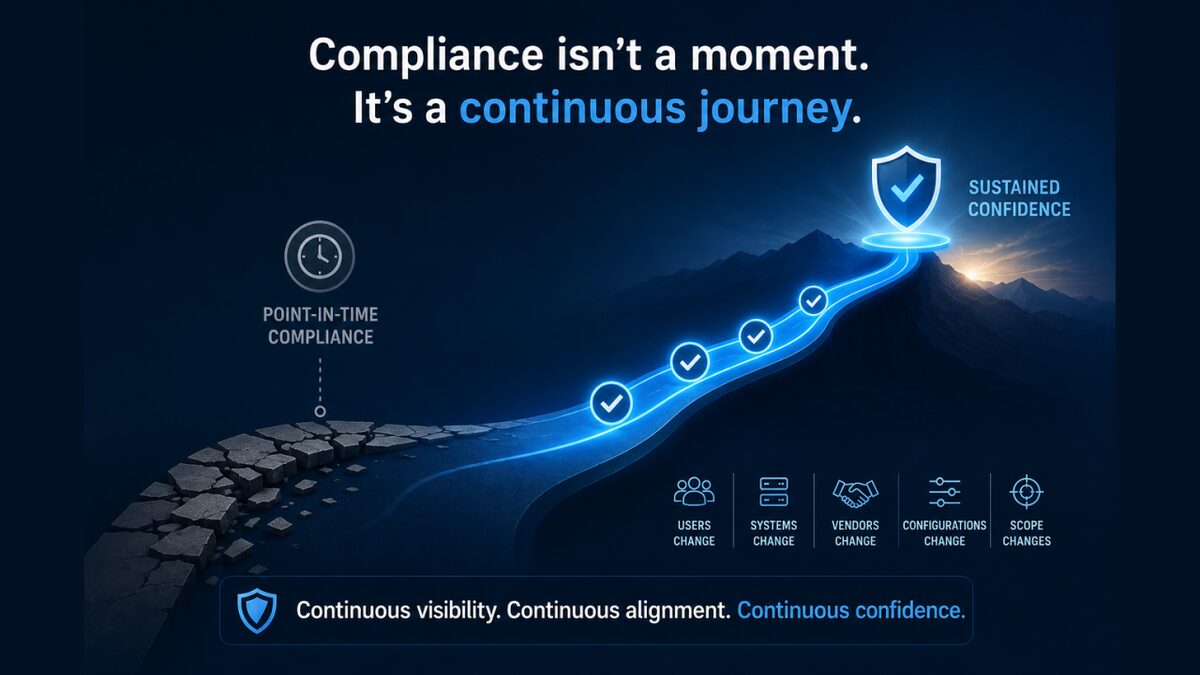
The business evolves.
The environment changes.
The documentation remains.
This is where confidence begins to erode.
Not because people stop caring.
Not because controls were never implemented.
But because understanding requires continual validation that the assumptions driving decisions remain true.
Complexity can certainly contribute to the problem.
However, even relatively simple environments depend on assumptions about ownership, priorities, dependencies, and risk.
The challenge may be less about reducing inputs and more about ensuring the information being used to make decisions still reflects the environment it is intended to describe.
Because collecting information is not the same as creating clarity.
And maintaining documentation is not the same as maintaining confidence.
Organizations rarely fail because they lack data.
They struggle because they cannot determine which information matters most, whether it still reflects reality, and what actions should follow.
The goal was never information for its own sake.
The goal was understanding.
Because information alone doesn't create confidence.
Understanding does.