A Practical Guide to Tracking CUI Across Your Environment
After defining your CMMC scope and avoiding common control mistakes, the next challenge is one most organizations underestimate: mapping where your CUI actually flows.
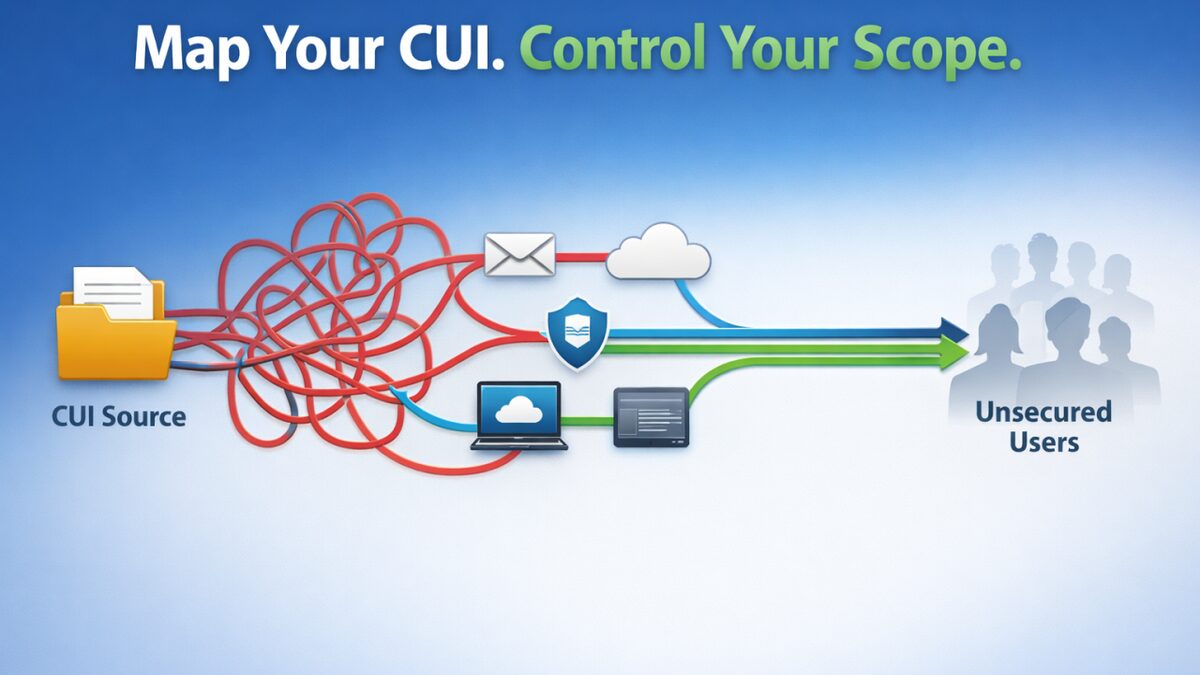
It’s not just about where CUI is stored—it’s about how it moves across users, systems, and processes. Without a clear map, gaps form, controls fail, and audits get messy fast.
The good news? You don’t need to overcomplicate it.
- Start With Your Known CUI Sources Identify where CUI originates in your organization:
-
Contracts
-
Government portals
-
Prime contractor communications
This gives you your starting point.
- Trace Real Data Flows (Not Assumptions) Follow CUI as it actually moves:
-
Email inboxes
-
File shares
-
Endpoints (downloads, desktops)
-
Cloud apps
💡 Tip: Ask users how they really handle data—not how policies say they should.
- Identify Every Touchpoint For each step in the flow, document:
-
Who accesses it
-
Where it’s stored
-
How it’s transmitted
If CUI touches it, it’s in scope.
- Separate In-Scope vs Out-of-Scope Systems Once mapped, draw a clear boundary:
-
Systems that store/process/transmit CUI → In Scope
-
Everything else → Out of Scope
This is where you start controlling complexity.
- Validate and Refine Your first map won’t be perfect—and that’s okay.
-
Review with technical teams
-
Validate with actual workflows
-
Update as processes change
CUI Mapping Checklist:
✔ Identified all CUI entry points
✔ Traced real-world data flows
✔ Documented users and systems involved
✔ Defined clear in-scope boundary
✔ Reviewed and validated with stakeholders
Mapping your CUI doesn’t have to be overwhelming—but skipping this step almost guarantees problems later. A clear, accurate map makes everything else in CMMC simpler, faster, and more defensible.