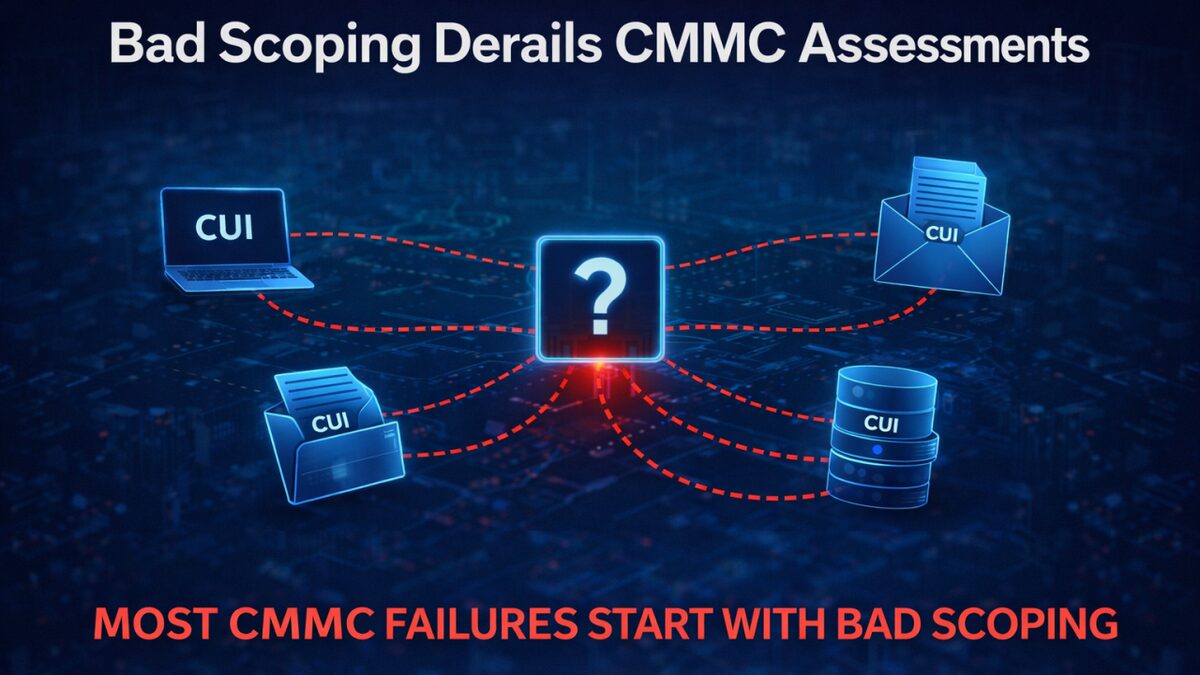
Most CMMC failures don’t start with weak controls. They start with bad scoping.
Before you implement a single control, you need to answer one question: where does your CUI actually live?
It sounds simple, but it’s where most organizations get tripped up. CUI doesn’t stay where you think it does. It moves through email, lands in shared drives, gets downloaded to endpoints, and ends up in places nobody planned for.
When your scope is wrong, everything built on top of it is wrong—your controls, your documentation, your POA&Ms. An assessor will find the gaps, and you’ll be defending an environment you didn’t fully account for.
Organizations that get scoping right do two things:
-
They trace actual CUI data flows—not theoretical ones—across every system, user, and process that touches it.
-
They minimize their boundary. The smaller your in-scope environment, the fewer controls you need to implement and the less surface area your assessor reviews.
A tight, well-defined scope isn’t just good compliance strategy—it’s good security. You’re concentrating your defenses where they matter most instead of spreading them thin across your entire network.