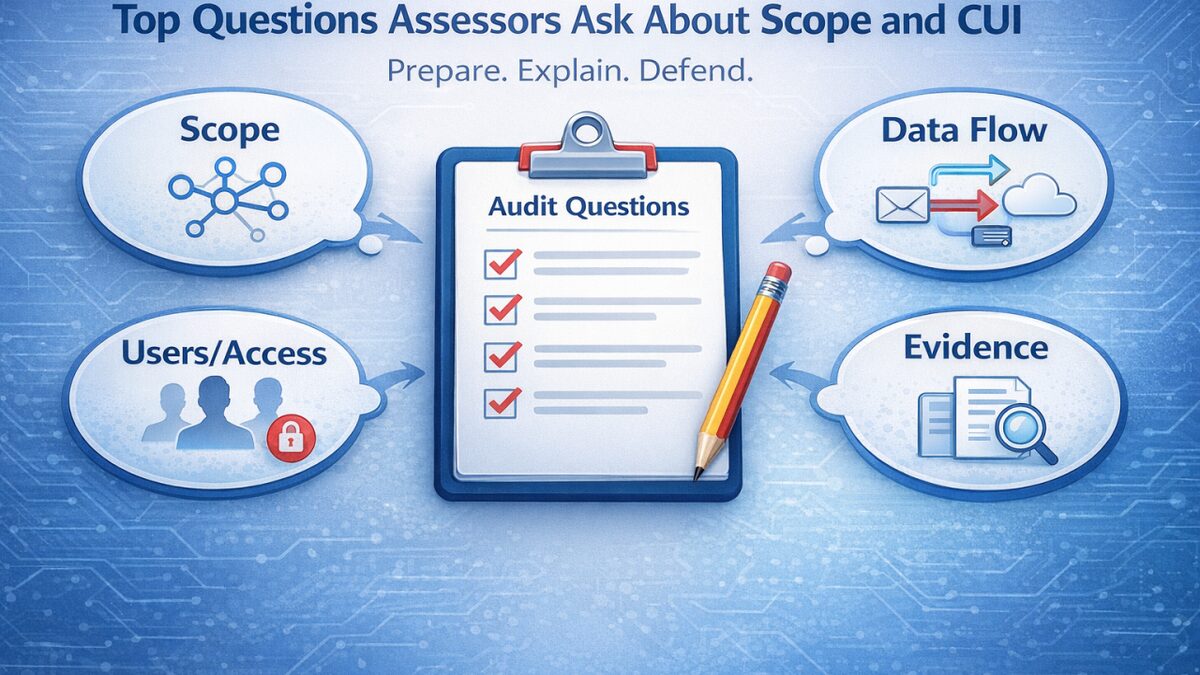
Top Questions Assessors Ask About Scope and CUI
By the time you reach a CMMC audit, your controls and documentation should already be in place. But here’s where many organizations get caught off guard: they’re not prepared for how assessors actually ask questions.
Assessors aren’t just checking boxes—they’re validating that you truly understand where your CUI lives, how it flows, and how it’s protected.
If you can’t clearly answer their questions, that’s where findings begin.
Top Questions Assessors Will Ask:
- “Where does your CUI live?”
-
Be ready to identify all systems that store, process, or transmit CUI
-
Vague answers = immediate red flag
- “How does CUI flow through your environment?”
-
You should be able to walk through real data flows
-
Include email, file sharing, endpoints, and cloud systems
💡 If you can’t explain the flow, your scope likely isn’t complete.
- “Who has access to CUI?”
-
Identify users, roles, and access controls
-
Demonstrate least privilege in practice—not just policy
- “How did you define your scope?”
-
Explain your methodology clearly
-
Show how you determined what is in-scope vs out-of-scope
- “How do you ensure out-of-scope systems stay out?”
-
Network segmentation, policies, and enforcement
-
Prove boundaries are controlled—not just assumed
- “Can you show evidence for this control?”
-
Be ready to quickly produce mapped, organized artifacts
-
This ties directly to how well you’ve structured evidence collection
- “How do you maintain this over time?”
-
Demonstrate continuous monitoring and updates
-
Show that your program isn’t static
Quick Audit Readiness Checklist:
✔ Clear CUI data flow mapping
✔ Defined and justified scope boundary
✔ Documented user access and controls
✔ Segmentation between in-scope and out-of-scope
✔ Evidence mapped and readily accessible
✔ Ongoing monitoring and updates in place
CMMC audits aren’t just about what you’ve implemented—they’re about how well you can explain, demonstrate, and defend it.
If you can confidently answer these questions, you’re not just audit-ready—you’re in control of your environment.